The Sock Line That Won't Fade... And The Heaviness That Arrives By 6pm:
Here Are 5 Signs There's Something Building Inside Your Leg Vessels That Nobody Has Ever Checked You For
The swelling isn't water. And it's not your age. There's something that's been building along the inside of your vessel walls for decades... and most doctors have never even looked for it.
Thousands helped · Rated 4.8 out of 5
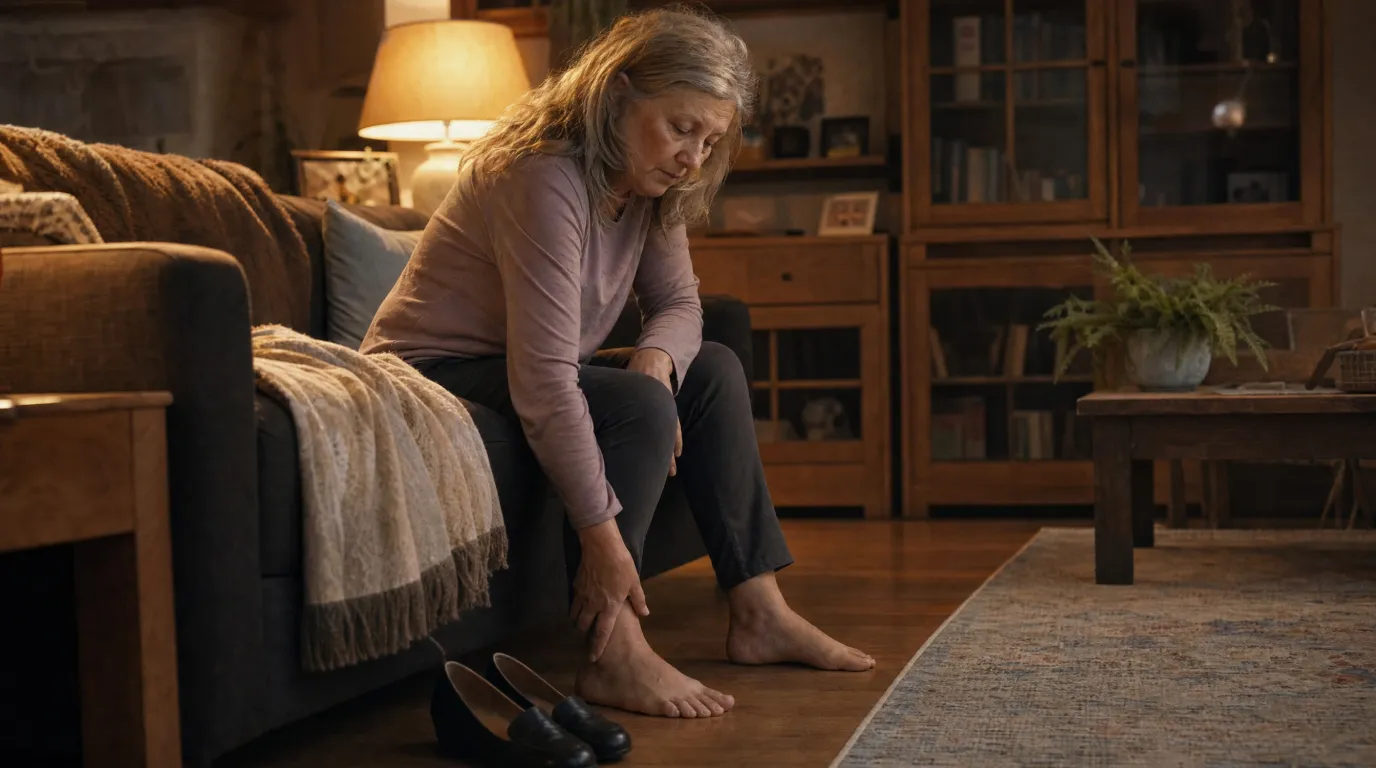
1. Your legs feel heavy by evening, even on days you barely moved
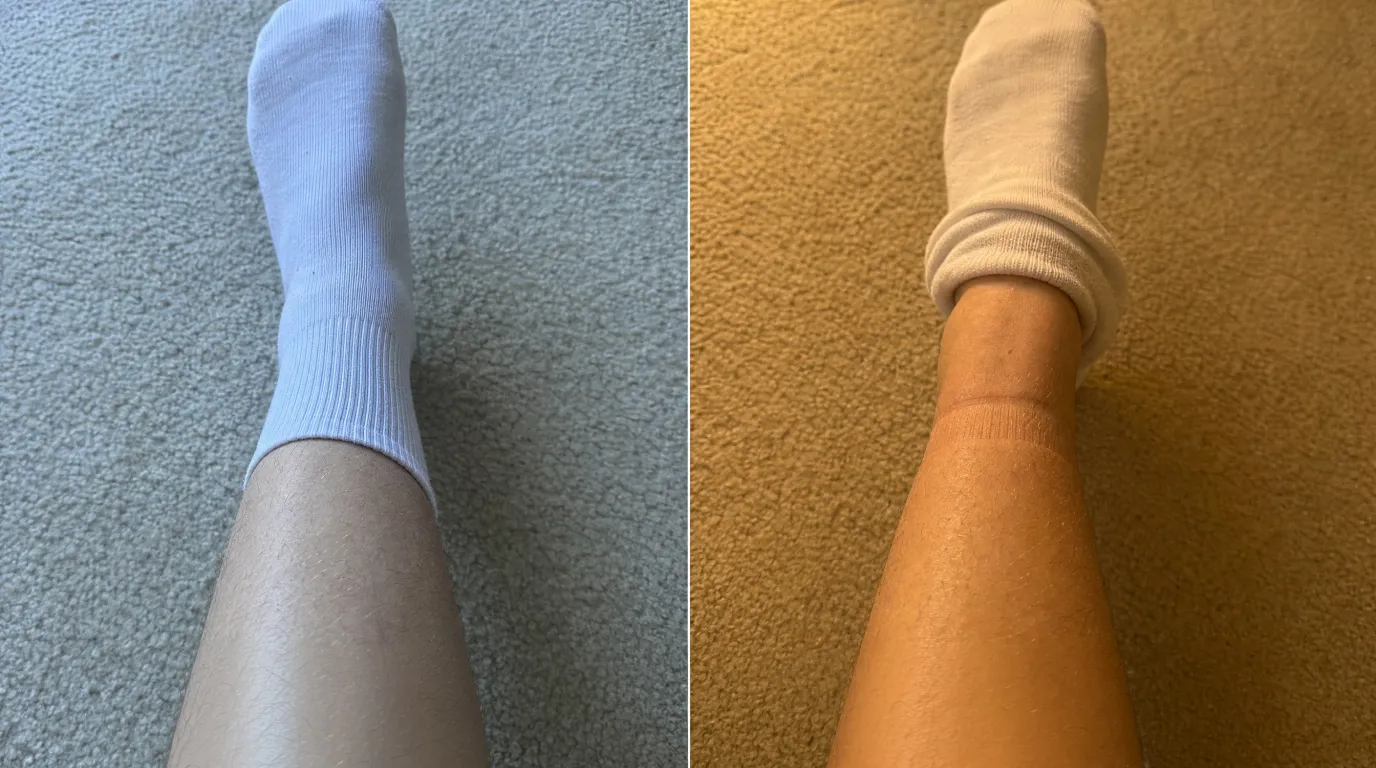
Not painful. Heavy.
You notice it when you take your socks off and there's a line pressed into your ankle that takes a while to fade. Or when your shoes fit differently at 6pm than they did at 8am.
You've probably filed that under standing too long. Or the weather. Or being 60.
But here's what's worth noticing: It happens on the days you did almost nothing too.
Heaviness that doesn't track with how much you actually did isn't about effort.
It's about how easily blood is moving back up out of your legs. And when that gets harder... your legs are the first place you feel it.
2. Your hands and feet run cold in a warm room

Everyone else is comfortable. You've got socks on in July.
Your fingers take longer to warm up than they used to. You've started noticing which chairs in the house are near a radiator.
Cold extremities are simply a flow problem showing up at the ends of the line first.
The smallest vessels in your body are in your fingers and toes. They're the furthest from the pump. The narrowest in the system. Which means they're the first to complain.
So anything that slows circulation shows up there... years before it shows up anywhere you'd think to mention to a doctor.
The protein layer behind those early clues
Fibrin is a stringy protein your body makes on purpose. Every time a vessel wall gets irritated, fibrin shows up like a repair patch and lays itself over the damage.
That's exactly what it's supposed to do.
The problem is what happens after 40 or 50 years of small repairs.
The patches don't get cleared away as efficiently as they used to. They layer. The inside of the vessel gets a little rougher. A little narrower. Blood has to work harder to move through it.
And here's the part worth understanding:
A clot isn't the start of this story. It's the last page.
This isn't some fringe idea somebody invented to sell you something. In the Edinburgh Artery Study, which followed more than 1,500 adults aged 55 to 74 for years, the people with the thickest blood were over 3 times as likely to suffer the kind of poor circulation that causes leg pain and cramping.
Read that again.
Because of what it does NOT say.
Not cholesterol. Not blood pressure.
How well the blood moved.
Which is the measurement nobody ever took on you.
And that's why the heaviness and the cold hands show up years before anything shows up on a test. They're the early, everyday version of the same problem.
This is also where everything you've tried starts to make more sense.
3. Tingling or burning in your feet, mostly at night

It usually turns up when everything else goes quiet.
A prickling in the soles. A warm, buzzing feeling along the top of the foot. Not painful enough to mention to anyone... but enough to make you move your feet around looking for a cooler patch of sheet.
Nerve endings are fed by the smallest vessels in the body. And they're unforgiving about supply.
When flow to them drops even slightly... they complain. And they tend to complain at night... when there's nothing else competing for your attention.
Most people put this down to the day they had. It's worth noticing whether it turns up on the quiet days too.
4. It gets worse the longer you sit still
The long car journey. The flight. The afternoon that got away from you at the desk.
You stand up afterwards and your legs feel like they belong to somebody else for the first minute.
Flow depends on movement. Your leg muscles are the pump that pushes blood back up toward your heart.
So when you stop moving... the return slows. And anything already narrowing those vessels makes the slowdown more noticeable.
If you've started planning around this... choosing the aisle seat, breaking the drive up, standing at the back of the room... then it's already changed how you live in small ways you didn't consciously decide.
5. You've been doing everything right and nothing has changed
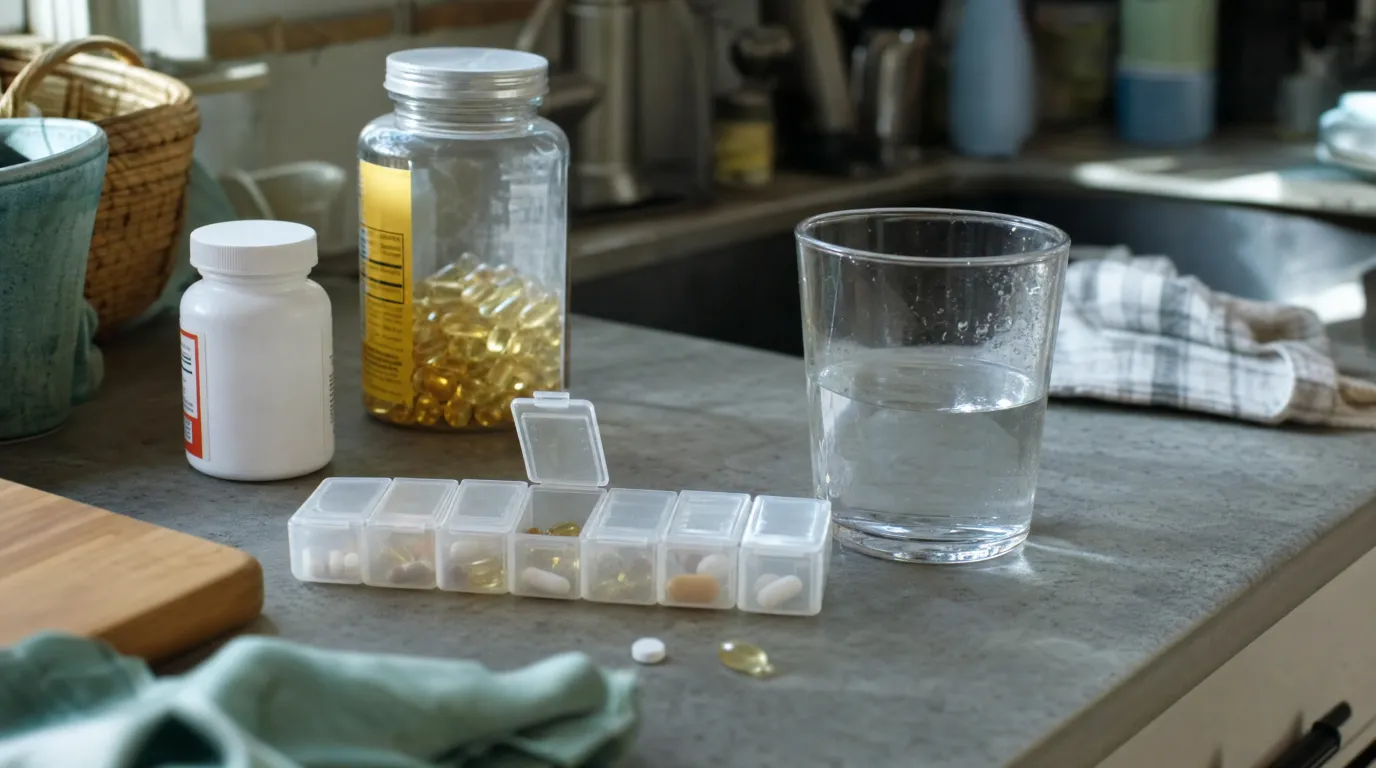
The compression socks you were told to buy. You did. About $45 a pair. You have 3 pairs now... because the first ones were the wrong strength.
The fish oil. Roughly $25 a month. You've been on it for 2 years without missing much.
The turmeric somebody at church swore by. Another $30 a month for the best part of a year.
The appointment you finally made because the swelling was bothering you. Around $350 once the visit and the ultrasound were settled.
It ended with a scan that found nothing wrong... and the advice to keep your legs up.
Like you hadn't already thought of that.
Add the water pills. The cushion under the ankles every evening. The salt you stopped putting on anything. The daily aspirin if you're on one.
That's comfortably past $1,400. And nearly 3 years of your life.
Every single item on that list was a reasonable thing to do. And you've done them consistently.
And your legs still feel the way they feel at the end of the day.
So let's be clear about something:
That's not a discipline problem.
Look at what that list actually does. Compression squeezes the leg from the outside. Water pills move fluid out through your kidneys. Elevation uses gravity. The supplements thin the blood or calm inflammation generally.
Every one of those works on the fluid. Or on the blood. Or on the pressure around the vessel.
Not one of them... is aimed at a layer of protein already sitting on the inside of the vessel wall.
You weren't failing at the routine. The routine was never pointed at this.
You weren't failing at the routine. The routine was never pointed at this.
If you recognized yourself in 3 or more of those and you'd rather see the 15-minute evening routine now, you can. Otherwise keep reading, because the next part is what that layer actually is.
Here's the part nobody wants to hear. (But I'm gonna tell you anyway.)
A tablet can't reach a protein layer sitting on a vessel wall. I know. You've been taking them for years. But compression works from the outside.
Water pills work on your kidneys. Elevation uses gravity. None of them were ever designed to reach what's actually sitting there. So what does?
Here's the honest answer. And it's why this page exists.
A tablet has to go through your stomach, into your bloodstream, and then act on whatever it was designed to act on.
That works well for chemistry. But it's a poor way to reach a physical layer sitting on a vessel wall.
A field doesn't have that problem.
It passes through tissue. Directly.
412 Hz is the number the circulation routine is built around. It comes off the frequency lists practitioners have worked from for decades.
In 2025, a review in the journal Bioengineering gathered up the research on what pulsed fields do to inflammation in soft tissue, cartilage and joints, and one of the areas it covers is angiogenesis, which is the formation of new blood vessels.
That's the bridge worth having. So let me put it plainly... rather than let you infer more than it says.
Nobody has run a trial of 412 Hz against swollen ankles.
What that review establishes is narrower... and still useful: a pulsed field isn't only doing something to bone. Vessels are on the list of tissues this technology measurably acts on.
Full transparency: 2 of that review's 4 authors work for a PEMF device company. Not this one. Different company entirely. Does that make the research wrong? No. Does it mean you should know who wrote it? Yes. I'd rather you have the full picture than trust me blindly.
Pulsed electromagnetic field therapy isn't a fringe idea. The FDA cleared it back in 1979 to help heal stubborn bone fractures, and clinics have used it every day since. A field reaching tissue is the established part.
What's new is aiming that kind of field at circulation, at a specific number, at home, for 15 minutes, on the part of you that feels heaviest.
And one thing that should go without saying but I'm going to say it anyway.
None of this replaces your aspirin, and nothing on this page is a reason to change anything your doctor has prescribed. Keep taking it exactly as you were told. This runs alongside it, aimed at the part the tablet was never designed to reach.
So what does a verified home unit look like?

For decades, the equipment used to generate and verify these signals lived inside clinics. A clinical unit could cost $10,000 to $15,000. A specialist session could cost $500 or more.
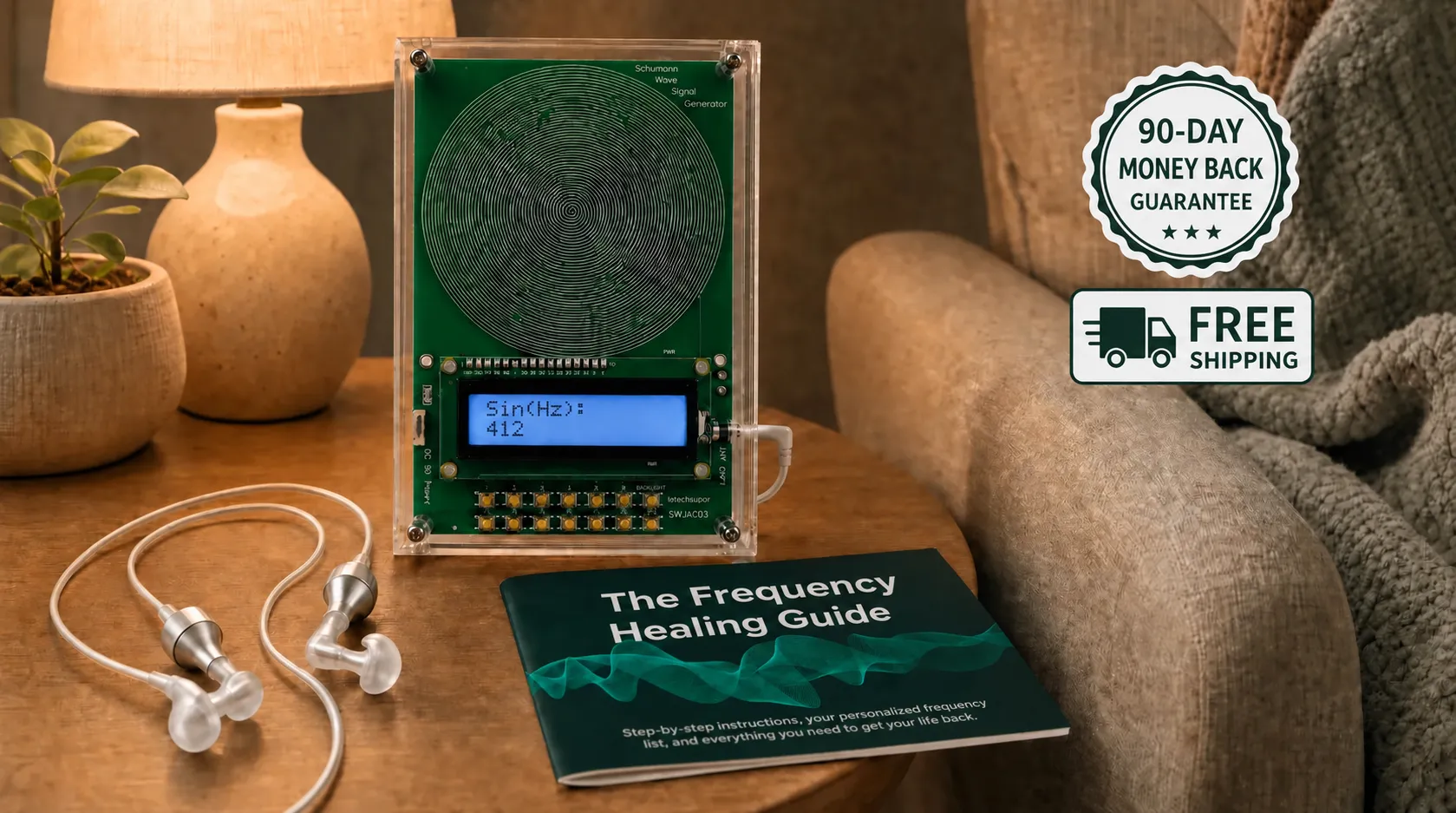
Calminity brings that verified-output process into a hand-held device made for home use. For a fraction of the cost. Without the appointment. Without the drive.
Introducing the Calminity Bio-Healing Frequency Generator
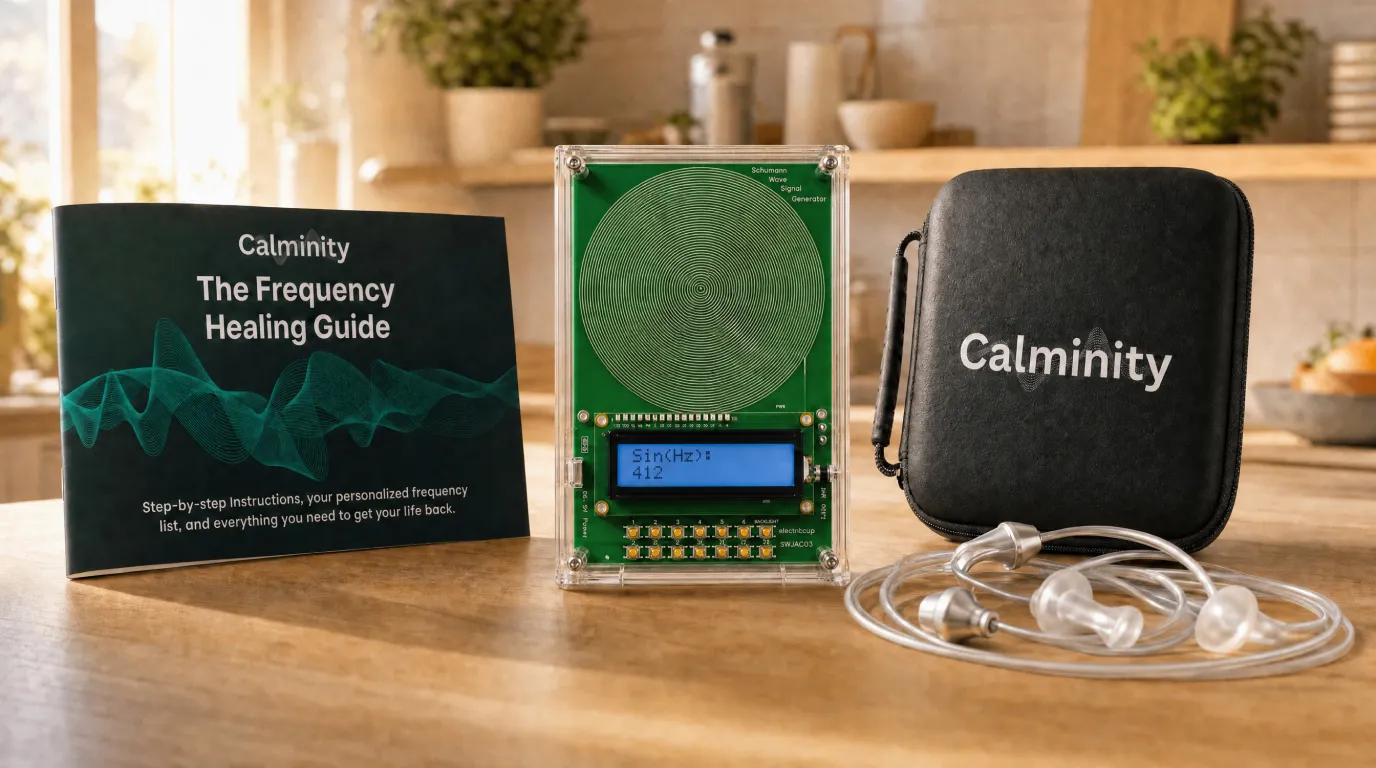
You plug it in. Set the number. Press the button.
No app. No phone. No account.
One dial. One button. 15 minutes.
For this... you set it to 412 Hz and put it near your legs while you're sitting in the evening anyway.
That's it.
Every batch's output is checked on an oscilloscope before it ships, so the number on the screen is the signal coming out of it. That check is the whole reason to buy a real unit rather than a $40 one off a marketplace.
The complete bundle includes:
- Calminity Bio-Healing Frequency Generator, tunable 0.01 Hz to 100,000 Hz, every batch oscilloscope-verified
- Anti-Radiation Earphones
- Protective Carrying Case
- The Frequency Healing Guide, in print
- "Your Body's Missing Frequency" eBook
- Full 1-Year Warranty
Total value: $300. Today: $79.
What Calminity users say:
★★★★★
More circulation in my legs, and clearer thinking with it.
Firstly I feel I'm getting more circulation in my legs and body, I'm thinking more clearly, less stress. I'm feeling better in my self.
Verified owner, post-purchase survey
★★★★★
The swelling in my legs eased.
Helps my swelling legs and neuropathy.
Verified owner, post-purchase survey
★★★★★
The burning in my legs eased off.
I had a lot of tingling and burning feeling in my legs which doesn't feel as bad.
Verified owner, post-purchase survey
Try Calminity for 90 days
Use it for about 15 minutes a day and give it a proper 8 weeks, because that's the window the people who report the clearest change actually gave it.
Here's the order most owners describe.
Week 1: The timing shifts before the swelling does.The tight, full feeling still arrives. It just arrives later than it used to. You'll notice it as an ordinary afternoon that got further along than usual... before your legs started asking for a chair.
Weeks 2 and 3: Standing gets cheaper. You're at the kitchen counter making something, and you get through it without the calculation about where to sit. The fluid that used to start gathering by mid-morning is waiting until the afternoon.
Weeks 4 to 6: You stop propping them up. You make lunch, you clear up after it, and at some point you realize you haven't put your feet on the cushion once.
Weeks 6 to 8: The sock line. You sit on the edge of the bed, take your socks off, and the groove is fainter than it was.
That's usually the one people can point at. Because it's the one you can see.
Not one of those is a cure and none of them is a promise. They're the checkpoints, in the order owners report them, so you know what you're watching for instead of hoping something happens.
If you don't feel the difference, send it back within 90 days for a full refund. You also get free tracked shipping and a full 1-year warranty.
The heaviness at the end of the day is the thing to watch. Not a number on a test. Not something anybody has to tell you. You'll know whether your own evenings feel different.
And none of this is really about your ankles.
It's about taking your shoes off at the end of the day... and not looking down first.
It's about standing at the kitchen counter long enough to finish what you started.
It's about saying yes to the walk on a Sunday... without running the math on what the evening will cost you.
There's no moment where you notice that shift happening. You just find, one evening, that you didn't think about your legs at all.
Whatever you've been taking, you took it for the part it was designed to handle.
This is a way to test what happens when you also address the part it was never designed to reach.
The layer doesn't pause while you decide.
It does that whether or not you've made your mind up about it.
The owners who report the clearest change? They gave it a steady 8 weeks.
Starting tonight and starting in the spring... are not the same decision.
Bundles are made in small batches, and the current batch is running low. If the button is live, it's in stock.
Safety note: The Calminity is gentle, drug-free, and non-invasive. It's an addition to what your doctor has you on, never a replacement for it. If you take a blood thinner or any anticoagulant, keep taking it exactly as prescribed and speak to your doctor before adding anything new. If you have a pacemaker or another implanted electronic device, are pregnant, or are undergoing treatment such as chemotherapy, check with your doctor before use. If you have sudden swelling, pain or redness in one leg, that's a reason to call a doctor today, not a reason to try a device.
Disclaimer: These statements have not been evaluated by the Food and Drug Administration. This product is not intended to diagnose, treat, cure, or prevent any disease. Results vary from person to person. Frequency associations reference community frequency lists and the historical work of Royal Raymond Rife.
References
1. Edinburgh Artery Study, a population cohort of more than 1,500 adults aged 55 to 74. Higher blood viscosity was associated with over 3 times the likelihood of peripheral arterial disease, the circulation problem that causes leg pain and cramping.
2. Cleveland Clinic, patient guidance on anticoagulants: they prevent new clots from forming and don't dissolve a clot that already exists.
3. Kaadan A., Salati S., Cadossi R., Aaron R. "Regulation of Inflammatory Responses by Pulsed Electromagnetic Fields." Bioengineering (Basel), volume 12, issue 5, article 474, 30 April 2025. Review article covering PEMF and inflammation in soft tissue, cartilage and joint healing, alongside angiogenesis. Declared interests: 2 of the 4 authors are affiliated with IGEA S.p.A., a manufacturer of pulsed field devices unconnected to Calminity.
4. U.S. Food and Drug Administration, clearance of pulsed electromagnetic field devices for the treatment of nonunion bone fractures, 1979. This clearance is for fracture healing. It's not a clearance for circulation, swelling or any condition described on this page.